A spine implant deck you can actually touch.
A 17-slide clinical education deck on adult spinal deformity, built for a surgeon and sales audience. Six of the slides are live — drag the C7 plumb line, explore spinopelvic parameters, and move the implant pore size in and out of the band where bone actually grows.
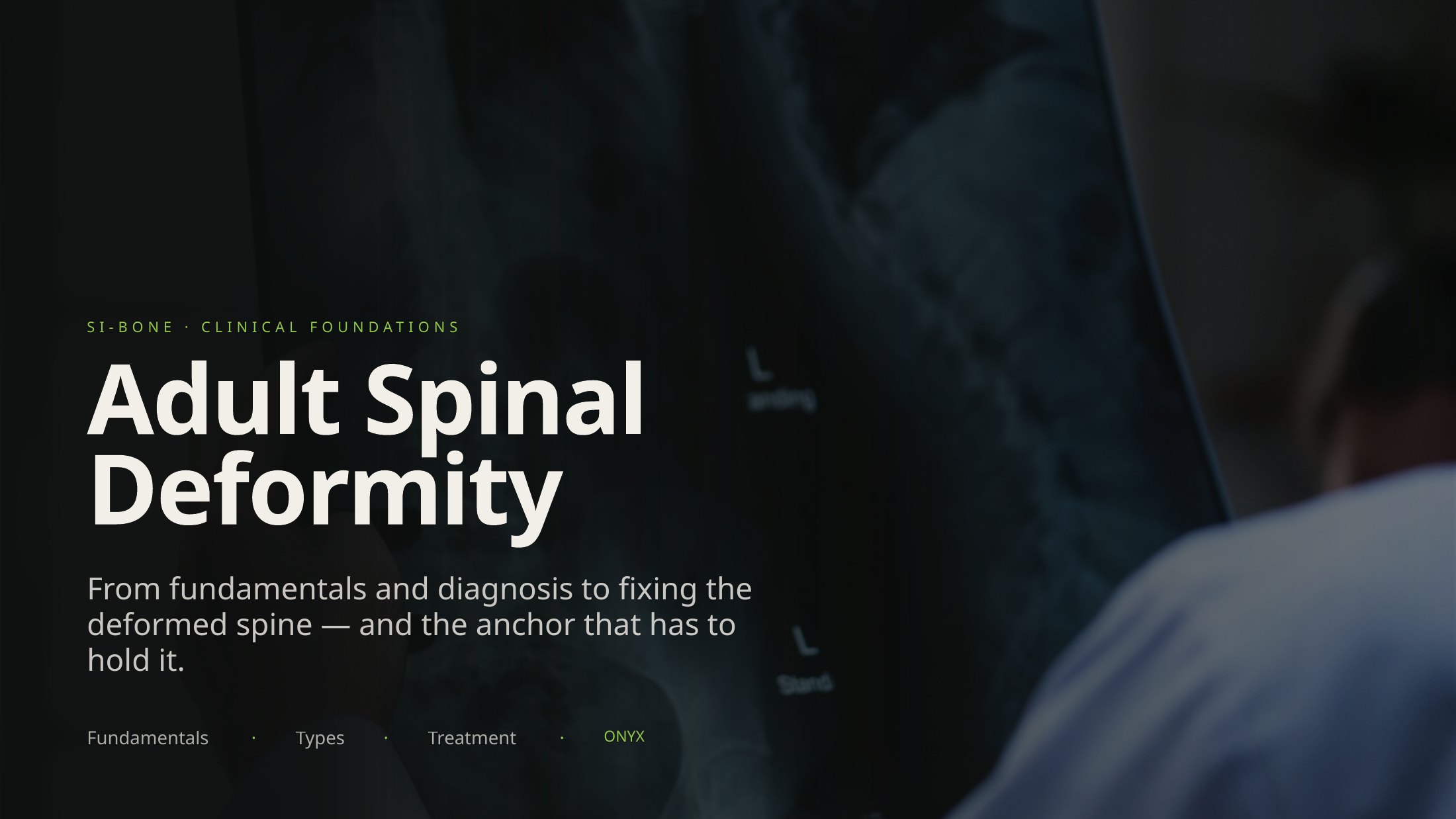
Marked slides are live and interactive — click, drag, and hover them.
Clinical education decks lose people on the geometry. Sagittal balance, pelvic incidence, and lattice porosity are spatial ideas trapped in static bullet slides — reps read them out, surgeons tune out.
I rebuilt the teaching moments as live interactions instead of illustrations. Six slides let the viewer move the variable themselves — the plumb line, the parameter, the pore size — so the relationship is felt, not asserted.
A 17-slide deck that works as a self-serve web experience and a presented deck. The product claim lands last, on top of a case the audience has already built for themselves.
- — 17 slides · 6 live interactions
- — Static illustrations → manipulable models
- — Product claim moved to slide 14 of 17
How the deck is built.
- Visual system
- Warm bone-white ground, near-black type, and a single clinical green accent reserved exclusively for the live element on each slide — so interactivity is never ambiguous.
- Narrative arc
- Fundamentals → deformity types → treatment → the anchor. The implant is introduced only after the clinical risk it addresses has been quantified on screen.
- Interaction design
- Every interaction resolves in one gesture — a tap, a drag, a hover — with a headline number and a plain-language verdict that changes in real time.
- Accessibility
- Keyboard-navigable deck, focus-visible controls, labelled ranges and tablists, and reduced-motion support. Every interaction is reachable without a mouse.
Need a deck your audience can explore instead of sit through?
Start a conversation